If you missed the UNITER Awards Gala, you can still see the part in which CNDB was present on the stage of the I.L. Caragiale National Theatre Bucharest.

Maia Axinte, winner of the CNDB 2020 Awards, and Robert Popa, a graduate of the CNDB Academy of Dance and Performance, staged an excerpt from the performance ” Val and the Citadel of Souls”, by Vava Ștefănescu. Our emotions and joy were immeasurable. Thank you, UNITER, for the invitation!

Eduard Gabia – from contemporary dance and performance art to film, music and back on the CNDB stage, or the artist who revisits his own choreographic path in three works that marked the recent history of contemporary dance

“Outcome”, by Manuel Pelmuș and “8 days a week” by Eduard Gabia, presented as double bill, on July 16 and 17 at CNDB.

There is very little being said about the artistic versatility of contemporary dance practitioners. Eduard Gabia is a significant example. Over time, he has fluidly crossed and experienced several areas, environments and artistic contents. In the 2000s, cultural institutions presented him as a choreographer and performer of works presented at international dance festivals. IMDb and Cinemagia announced him as a cast actor in the lead roles of several international film productions. Currently, the websites of clubs and music festivals mention him as the founder and percussionist of an electronic / synth pop / new-wave music duo called Karpov not Kasparov, who recently signed a contract with the Disco Halal label from Berlin.

Trained as a dancer and choreographer, the artist Eduard Gabia returns to the stage of the National Center for Dance Bucharest in a triple stance: that of a performer in the initial version of the work “Outcome”, by Manuel Pelmuș, which he revisits with his own body 20 years later, and that of an author who enters his own work for the first time – “8 days a week” – 15 years after its premiere at the Kaaitheater Brussels in 2006. The two performances will be presented as a double bill, on July 16 and 17 at CNDB. The performance 8 days a week” also creates the opportunity to reunite with the dancer Carmen Coțofană, one of the performers in the initial cast of the work. The third position in which Eduard Gabia will be present is that of a performer in “Stars High in Amnesia’s Sky (reactivations)”, by Mihai Mihalcea, which will be presented at CNDB, on July 24 and 25.

“Outcome” by Manuel Pelmuș is one of the most daring choreographic works created in the early 2000s in Romanian contemporary dance. Outcome was seen as a kind of short circuit, a shock, which for many of the young choreographers and critics of that time produced a disruption of the French aesthetics, which had really left its mark on Romanian choreography after the project “La Danse en Voyage”, organized in Bucharest in the early 90’s.

Manuel Pelmuș considers that this is the first piece that debates what choreography means for him, the body’s standing in society, artistic and political influences, all in which “a manner of choreographic thinking materializes, closer to the performance of visual arts and certain conceptual searches in choreography”. The artists talks about Outcome as a work that informed and influences everything he did afterwards, even if in different forms or setups:

“Outcome started a form of critical reflection towards the means of artistic production and the conventions and context in which they take place. The main merit (if not all of it) for the work is Eduard Gabia’s. We were friends and, one day, I told him about my idea. Edi was very open and pervious, he fully understood the artistic proposal, even if the concept was quite uncommon for him, but for me as well. What followed was a period of rehearsals and discussions, during which the piece evolved naturally, supported also by Edi excellent performance abilities. It was not a working process in the traditional sense, one in which I showed some moves and he tried to do them as well as he could. It was more of a process of accumulation, in which we fed each other ideas and feelings, adding movement details as we went along, and finally everything came together as Outcome. I remember that we talked about the relationship between object and subject, between presence and expression, between body and context.”

Manuel Pelmuș, 2020

“8 days a week” is the performance created by Eduard Gabia and presented for the first time in 2006 being a co-production of CNDB and Kaaitheater Bruxelles. In order to create the work, the artistic team from back then (Eduard Gabia, Carmen Coțofană, Maria Baroncea, Florin Fieroiu, Brynjar Bandlien and Beniamin Boar) benefited from a creative residency at Kaaitheater, one of the most prestigious European contemporary dance theatres, where they also presented the performance two times.

8 days a week is a performance built on an ingenious practice of movement, which Gabia experienced playfully himself before developing a whole set of tools that he delivers to the dancers for their own use. Nothing simpler, nothing more difficult.

“In the reality of the world around us, our actions are composed of two types of interaction, Gabia tells us. Informational – we have the necessary knowledge for that action. Energy – we know and have the exact amount of energy to perform that action. The action is the meeting point of the two perspectives, which in 8 days a week I tried to unbalance, turning each action into a “failure”, into a “mistake”. And from one mistake to another, a normal, natural reality gathers.”

Eduard Gabia

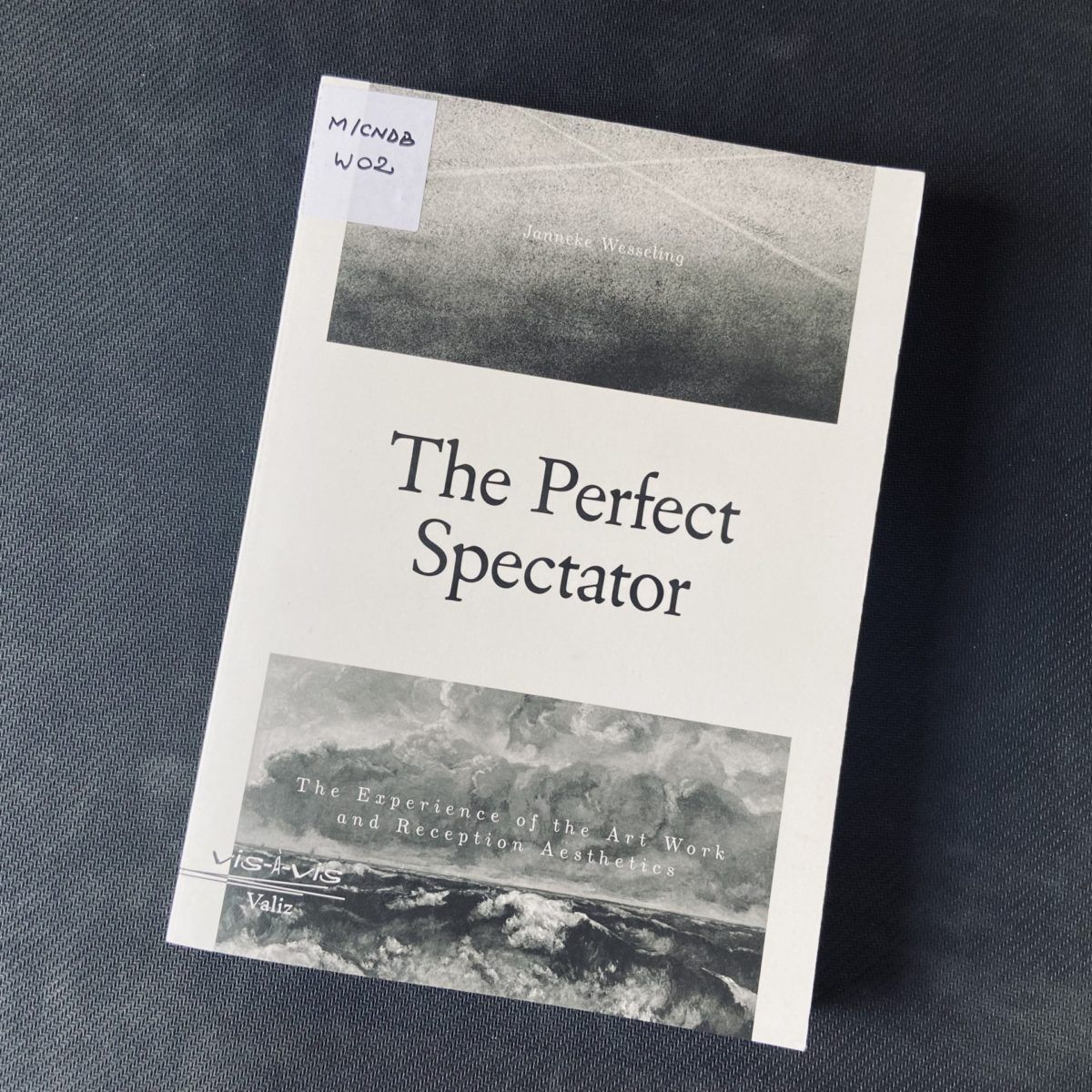
Choreographer Andreea Novac’s recommendation from the CNDB Media Library: The Perfect Spectator

We invite artists who cross the threshold of the CNDB Media Library to tell us a few words about the materials they have chosen and to share with us the ideas that stayed with them. Choreographer Andreea Novac chose “The Perfect Spectator”, a book about the way we perceive art.

What happens when a spectator encounters a work of art? How does the viewer understand its “meaning” and how can this process of interpretation, which often takes place at a subconscious level, beyond language, be understood and articulated? These are the questions from which the book chosen by Andreea Novac starts.

Regarding the choice she made, the choreographer told us the following:

Artistic reception was, more or less explicitly, a constant in the works we have proposed so far, as we became aware of the fact that the relationship between the spectator and the artistic product goes beyond the simple act of watching. The verbs used to designate the spectator’s interaction with an artistic product have also changed, moving to participate, to accompany, to experiment, to transform, to intervene, etc.

“The Perfect Spectator” has nothing to do with an ideal spectator, but rather offers ways and tools to understand, lead, mobilize and direct artistic perception and experience, approached from both directions (from stage to audience and vice versa).

Andreea Novac

Author Janneke Wesseling, professor of visual arts at Leiden University in the Netherlands, addresses the relationship between the spectator and the art object by analysing the aesthetics of reception, with the central premise that contemplating art is a matter of interaction between an active work of art and an active observer. Wesseling writes about these things both from a personal position, starting from her own encounters with art objects, and from her professional experience, studying and writing about art. At the meeting between the two perspectives, she arrives at a new theoretical framework for seeing and contemplating art.

Andreea Novac selected some excerpts from “The Perfect Spectator” – ideas that resonated with or remained with her after reading, and shared them with us. You can read them below:

“The artist may not necessarily understand his own art. His perception is neither better nor worse than that of others”. – Sol LeWitt

“There is not a one to one relationship between an artist’s intention and a spectator’s interpretation. (…) It by no means entails the exact transference of knowledge and experience from artist to spectator. (…) The spectator, be she uninformed or well – informed, is asked to disregard her expectations and preconceived ideas about what art is about. Our expectations of the art work stand in the way of experiencing it.”

“Two kinds of spectators: eye and body.”

“The art work is embodied or materialized thinking.”

“The concept of spectatorship that elevates sight above all other senses, a spectatorship of a disembodied subject, is not relevant to postmodern art with its emphasis on a simultaneity of perspectives and experience of the work with the entire body.”

“The art work exists and lives in the contemplation by the spectator and in the ever-changing interpretation. The work’s maker does not know all the possible layers of meaning and interpretation. Had he known them, he would have had no reason for making the work. The art work is not the ultimate goal, not an end product of the artist’s thinking. It is an intermediate stage, a temporary pause, a frozen moment in a thinking process. As soon as the artist has placed the work in the world, his activity concerning that specific work is a thing of the past. At that point, the spectator, the audience becomes involved in the work.”

The book “The Perfect Spectator” is available in the CNDB Media Library. You can access the entire books and videos collection by clicking here. If you are interested in any of the titles, write an email to corina.cimpoieru@cndb.ro.

The series of recommendations continues!

CNDB media library has over 400 books waiting for you to discover them as well as a whole video collection of works, dance films and video art. You will find titles about the history and theory of dance, critical thinking, performance theory, artist books, feminist studies as well as many periodicals, magazines and catalogues of contemporary dance festivals.

Two performances from CNDB were selected for the Antistatic International Festival for Contemporary Dance and Performance

Two of the performances produced in 2020 at CNDB, together with the first generation of graduates of the CNDB Academy of Dance and Performance, “Less might be more, but sometimes less is just nothing” by Willy Prager and “Coreomaniacii” by Simona Deaconescu, participate in Antistatic International Festival for Contemporary Dance and Performance, which takes place between May 20-28, 2021, in Sofia.

After a year of courses and workshops, the formed teams went through an intensive process of practice and live presentation. Ten choreographers worked together with the students from the CNDB Academy of Dance and Performance to bring back to stage well-known older works of theirs, but also to propose new ones. The performances selected for Antistatic are among the newly created productions. Thus, ten of the CNDB graduates will debut on the international stage, the two works being presented at the festival on June 5 and 6.

Antistatic is a platform for new forms and practices in contemporary dance and performance. Discover the festival program here.

CNDB calls for international partnerships for the Academy of Dance and Performance 2022-2024 edition

CNDB is looking for partnering organisations from Norway, Iceland and Liechtenstein for the second edition of our educational programme, the Academy of Dance and Performance CNDB (2022-2024).

The Academy is an artistic formation programme in contemporary dance dedicated to young emerging dancers and performers, launched by CNDB in the 2019-2020 academic year.Throughout the program, participants attend a two-semester intensive training in contemporary dance techniques and practice in the creation process of new works that are presented on the stage of CNDB. 

The first semester focuses on training and learning, based on a customized curriculum and with a corpus of trainers composed of international and local choreographers and pedagogues. It includes dance classes, workshops, research and individual study, as well as sessions of evaluation and feedback. 

During the second semester, besides the teaching-training activity, the focus switches onto involving the young dancers in local artistic productions. Established Romanian and international artists are working with the students in new choreographic creations, produced by CNDB through this program. 

The second edition of the Academy is scheduled to take place during 2022-2024 the academic years. In this respect, we are applying for funding with the RO-CULTURE EEA grants (https://www.ro-cultura.ro/en/calls/access-to-culture/call-2122-s2 – 2021 call to be published) and we are looking for partner organisations with experience in carrying out educational projects that want to take on the following:

  • Identifying and enabling contracts with one or two experienced contemporary dance trainers to teach in Bucharest within the Academy for a period of 3-6 months;
  • Hosting and organising an knowledge dissemination and exchange event of and work practices 

We invite those interested to engage in a further dialogue in order to identify other ways of interaction and cooperation. If your organisation is interested in this partnership, please contact our Education & Formation Programme Coordinator, Ana Papadima, at ana.papadima@cndb.ro.  

Works produced within the first edition of the Academy, presented in the „Dance me to the End of…”(exercises, distances, approaches) programme:

For more information about the Academy for Dance and Performance CNDB, click here.

CNDB Media Library: Irina Marinescu recommends The Mind-Body Problem

Irina chose The Mind-Body Problem, by Jonathan Westphal, as she is interested in philosophical concepts “about the meeting place between body and consciousness, between palpable and impalpable”. While reading it, Irina also shares with you a microtonal, musical recommendation.

Philosophers from Descartes to Kripke have struggled with the glittering prize of modern and contemporary philosophy: the mind-body problem. The brain is physical. If the mind is physical, we cannot see how. If we cannot see how the mind is physical, we cannot see how it can interact with the body. And if the mind is not physical, it cannot interact with the body. Or so it seems.

“The mind is a non physical thing

The body is a physical thing

The mind & body interact

Physical and nonphysical things cannot interact

Of the 4 propositions, 3 can be true at the same time. If they are, the 4th is false.”

The Mind-Body Problem, Jonathan Westphal 

In this book the philosopher Jonathan Westphal examines the mind-body problem in detail, laying out the reasoning behind the solutions that have been offered in the past and presenting his own proposal. The sharp focus on the mind-body problem, a problem that is not about the self, or consciousness, or the soul, or anything other than the mind and the body, helps clarify both problem and solutions.

Westphal outlines the history of the mind-body problem, beginning with Descartes. He describes mind-body dualism, which claims that the mind and the body are two different and separate things, nonphysical and physical, and he also examines physicalist theories of mind; antimaterialism, which proposes limits to physicalism and introduces the idea of qualia; and scientific theories of consciousness.

Qualia is also the notion that interested Irina Marinescu for some time, so she extracted the following excerpt from the book:

“The term “qualia” has an interesting and one might say chequered history. In the past the phrases and words “cogitationes”, “ideas”, “experiences”, “sense data”, “qualities”, “perceptions”, “sensations”, “properties of sensations”, “percepts”, “raw feels”, “nomological danglers”, “phenomenal properties”, and “qualitative properties” have been used to try to get at something approximately like the same idea.
The confused history of the different terminologies is enough to alert the thoughtful student of recent philosophy to the fact that all is not as it should be in the kingdom of the qualia.”

The Mind-Body Problem – Jonathan Westphal 

Finally, Westphal examines the largely forgotten neutral monist theories of mind and body, held by Ernst Mach, William James, and Bertrand Russell, which attempt neither to extract mind from matter nor to dissolve matter into mind. Westphal proposes his own version of neutral monism. This version is unique among neutral monist theories in offering an account of mind-body interaction.

The book The Mind-Body Problem, by Jonathan Westphal is available in the CNDB Media Library. With a click here you can access the entire CNDB book collection, as well as video. If you are interested in any of the titles, we invite you to write an email to corina.cimpoieru@cndb.ro

Who is Irina Marinescu?

Irina fell in love with contemporary dance in 2009. Since then, she has studied various dance practices ​​and forms of the performing arts. She worked for CNDB, participated in the Academy of Cultural Management 2019 and is currently an independent artist and producer, being one of the founding members of the Developing Art association.

She collaborates with artists from different backgrounds to create contexts where authentic connections, experiment and emotion are the main ingredients. Find out more about Irina Marinenscu’s practice in the video below.

The series of recommendations made by artists from the CNDB Media Library continues!

Music recommended by Irina, as background while reading the book

Are you interested in developing your artistic practice in an academic structure? The application for the Master Solo/Dance/Authorship (SODA) program at the Hochschulübergreifendes Zentrum Tanz Berlin (HZT) is now open!

“MA SODA is taught in English. It is designed for students wishing to undertake a consistent and structured development of their artistic research, practice and its context. It offers a rigorous grounding in how to write, situate and talk about one’s artistic practice and helps to frame, document and present students’ work in different formats. The programme includes a broad spectrum of international guest lecturers as well as members of the independent Berlin art scene.”

For further information on applying, click here.

Contact: soda_support@hzt-berlin.de
Deadline: 1st of April

Open call for Studio Light Moves

Studio Light Moves is an initiative of the Light Moves Festival of Screendance, aimed at investing in and nurturing creative process and enquiry in dance, technology and screen-based dance practices.

In partnership with Dance Limerick, The Digital Media and Arts Research Centre UL, Studio Light Moves is delighted to announce its 2021 development programme, Open Futures.

Open Futures 2021 is a test ground and critical exchange residency-based platform for dance artists and media artists interested in collaborating to explore the intersection of dance with media and screen-based practices. The project will enable 8 artists, consisting of 4 collaborating pairs, from the fields of dance and the digital arts, to investigate and explore the potential for interdisciplinary exchange that encompasses practices for the stage, gallery, installation, and outdoor settings. With an emphasis on creative process, the project will facilitate experimentation and exploration of methods and approaches. This process will occur within a mentored and technically supported environment.

Applications are welcomed from individuals or proposed duo partnerships between a dance artist and a media artist at any career stage. Successful individual applications will be matched with corresponding partners

KEY POINTS
Open Futures 2021 is designed around a two-week creative process residency for 4 dance and

media artist pairs, peer exchange and facilitated discussions with practitioners working in dance and technology and a €5K continuity bursary awarded to one selected artist pair to continue beyond the residency period.

Open Futures 2021 supports dance artists and media artist’s time, space, and equipment to work in collaboration over 2 weeks. Applicants may either propose their own collaborator or request to be partnered with one working in their area(s) of interest. (In this instance Light Moves and consultants will match collaborators in relationship to interest and experience.)

Open Futures 2021 aims to focus on collaborations in between dance and digital media practices including: video mapping, real-time image capture and/or generation, motion sensors, cinematography, coding, immersive video, game engines, real-time/interactive sound, generative audio and moving image installation methods. Applicants will be asked to describe the area(s) they wish to explore, what access to the related technologies and software they already have to hand and to specify what may be additionally required for this research process. It is anticipated media artists will have access to their own laptop and related software. All dance genres are welcomed.

APPLICATION
Please submit the information outlined below in one pdf or word document, via email to info@lightmoves.ie

1) A statement of interest including the below: (500 word max)
– Why are you interested in this interdisciplinary residency period and what it would mean in your practice currently.
– What are your artistic aims for the residency period and what technology/media area will be explored and why.
– What additional technical requirements you envisage as part of your research. Please provide as much detail as possible to help us facilitate you via technical support and mentorship/advice.
– Briefly identify a second technical area of interest you are open to exploring.
– Any additional information that you feel is relevant and wish to include.

2) For media artists applying, please state the kind of tools, software or hardware that you are comfortable in using and may intend to use during this residency.

3) Your CV and (if relevant) the CV of your proposed collaborating artist. Note: If you don’t have someone in mind Light Moves will work with you to find a suitable person relative to your area of interest.

4) 2 video links to previous work to demonstrate track record in existing practice.

KEY DATES
Application Deadline: Friday 5th March
Announcement of selected artists: Early – mid March
Residency week 1: 28th June – 3rd July
Residency week 2: 27th Sept – 2nd Oct

For the complete details click here.
For the info source click here.

A new open call for residencies at PACT Zollverein

PACT Zollverein announces a new call for residencies for the development and realisation of projects and productions, which is open to professional artists from both Germany and abroad working in the fields of dance, performance and media art.
The residencies will take place between August and December 2021 and include a working space and local accommodation as well as financial support in the form of a weekly grant allowance and travel costs, as well as technical assistance.

A residency incorporates the following:

― Studio space (from 69 to 173 sq.m.)
― Local accommodation (max. 4 people)
― Minimum period of 4 weeks
― Weekly grant allowance for all of the residency project participants (max. 4 people)
― Travel costs covering one journey only per participant to and from PACT Zollverein (max. 4 people)*
― Technical equipment (by arrangement and subject to availability)
― Professional technical support (by arrangement and subject to availability)

We only accept residency applications submitted via our online residency application process. To access the online application form please click here.

Closing date for applications: 25th of February 2021

Contact: residenz@pact-zollverein.de

All complete applications received by this date will be considered and you will be informed of the panel’s decision by e-mail.

PACT Zollverein / Choreographisches Zentrum NRW Betriebs-GmbH and its residency programme are supported by the Ministry for Culture and Sciences of the State of North Rhine-Westphalia and the City of Essen. Tanzlandschaft Ruhr is supported by the Kultur Ruhr GmbH.

To find out infomation regarding the residencies program offered by the National Dance Center Bucharest, click here.

Join the School of Disobedience Classes!

“School of Disobedience” is a nomadic, experimental and non-formal performanceart school and fight club at the same time, based on questioning, criticizing, protesting, resisting and defying. Composed of thematic classes, the program introduces the concepts of oppression, domination, exploitation, marginalization, powerlessness and violence from a critical feminist perspective. The school is free of charge and open for all women, independent of age, nationality, professional or educational background. Following the last class, participants present their works in the frame of outdoor public space showings.

“Defy norms, undermine tropes, express criticism of structural and ideological concerns.”

School of Disobedience Registration

The Spring Trimester 2021 is composed of 3 online and 6 live classes.

​It is not compulsory to follow all classes, participants can register independently for each of them.

online classes
CLASS 1: “Performance Art: An introduction”
20 February:  10-13h
The Zoom link will be sent you by email following your registration.

CLASS 2: “Performance Art: An introduction”
27 February:  10-13h
The Zoom link will be sent you by email following your registration.

CLASS 3: “Performance Art: An introduction”
6 March:  10-13h
The Zoom link will be sent you by email following your registration.

live classes
CLASS 4-5: “Who is the boss?”
20 March:  14-20h
21 March:  10-15h
+ Final outdoor showings (optional)

CLASS 6-7: “UTOPIA/DYSTOPIA”
27 March: 14-20h
28 March:  10-15h
+ Final outdoor showings (optional)

​CLASS 8-9: “The Sacred Ritual”​
22 May:  14-20:00h
23 May:  10-15:00h
+ Final outdoor showings (optional)

during the classes, activities will involve
Performance, dance, acting, puppet theater, narrating and composing through structured-improvisation and movement; discussions, screenings and readings from texts by writers, theorists, artists; movement research ; developing scores for solo and group choreographies; creative writing in different form (poetry, manifest, comics, diary…) making exercises and creative tasks in different medium (drawing, paining, collage, video, photo, installation art, multimedia art…), searching through storytelling, personal narratives, historical material, archives and divers audiovisual resources.

class description
At the beginning of each class, through joint analysis of historic and contemporary examples, students will approach different discourses connected to the topic. Building on these discussions as well as on selected readings, creative exercises and tasks, students will be guided to explore various approaches and elaborate thematic performances, texts, images and objects. With embracing multiple media, students will be invited to challenge artistic conventions and traditional canons, propose new forms, aesthetics, alternative, experimental solutions in order to defy norms, undermine tropes, express criticism of structural and ideological concerns.

methodology
“Art-based unlearning”, and more broadly, art education conceived as a critical practice, is a cross-disciplinary approach using artistic skills, processes and experiences as tools to take an active part in the social and political discourse on women’s empowerment and rights, and to enhance their emancipation by the means of education and art. The goal of “art-based unlearning” is to create immersive learning experiences via readings, discussions, creative exercises in various artistic forms (visual arts, performing arts, creative writing…), so as to make women gain new insights and perspectives, develop critical thinking and confidence. During the classes, participants have the opportunity to experiment in a safe, judgement-free zone where they can express themselves most honestly while receiving the support, knowledge and tools to grow confidence and strengthen their personal performance persona.

final public showing
Following the last class, participants will present their works in the frame of a series of outdoor totally free of charge public space showings (performances, exhibitions, ceremonies, rituals…).

Source: https://www.schoolofdisobedience.org/

Onassis AiR 2021/22 Open Call

Onassis AiR 2021/22 Open Call
THE SCHOOL OF INFINITE REHEARSALS: MOVEMENT V – VIII

FULL OPEN CALL DESCRIPTION & APPLICATION FORM HERE
DEADLINE: FEBRUARY 26, 2021 AT 12:00, NOON (COORDINATED UNIVERSAL TIME, UTC+02:00)

THE LINK TO THE APPLICATION FORM

Onassis AiR, the (inter)national artistic research residency program in Athens (Greece), invites artists, curators, designers, activists, collectives, educators, legal advocates, performance makers, economists, architects, filmmakers and other practitioners from any medium of expression or discipline to apply for the second iteration of The School of Infinite Rehearsals: Movements V–VIII, running between September 2021 and June 2022.

Governance: On Self-Organization & Institutions
Movement V: Self-Organization
September 6–October 24, 2021

Movement VI: Institutions
November 1–December 19, 2021

Economies: On Community Economies & Philanthropy
Movement VII: Community Economies
February 28–April 17, 2022

Movement VIII: Philanthropy
May 2–June 19, 2022

Conceived as a collective research program, The School of Infinite Rehearsals brings together an interdisciplinary group of participants to exchange knowledges and practices around two research topics that we find urgent to address today. For our second year, we will look inwardly and also outwardly, for the spatial and temporal structures that affect the ways we live, act and come together. How do we relate to others and how do we organize our decisions? What modes of governance do we adhere to and how do we shape them? What economic systems do we choose to be complicit in and how much agency do we claim to implement radical alternatives? How do we institute our knowledge(s) and acknowledge our institutional complacency or complicity?

In fall 2021, Movement V & VI will collectively explore issues of governance, delving into self-organization (Movement V) and institutions (Movement VI).

In spring 2022, Movement VII & VIII will tackle areas of economies, with a focus on community economies (Movement VII) and philanthropy (Movement VIII).

Onassis AiR is not looking for answers, but rather for questions, intricacies, aspirations, intuitive strategies that need to be tested, and for ways to imagine other modes of functioning as societies. In conversation with our current participants, we are transforming to further expand and foster our collective and horizontal ways of thinking and practicing together. For this reason, there will be no conveners or mentors. The 2021/22 Movement Groups (V-VIII) will be convened by the participants themselves, who will co-shape the curriculum according to their proposed individual research interests.

The selection for the Onassis AiR 2021/22 open call will be done in two phases. Phase I follows a peer-to-peer blind-selection method by the current participants of Onassis AiR 2020/21. During Phase II the selected applications will be reviewed by the Onassis AiR team together with an advisory board consisting of Grégory CastéraBinna Choi & Marianna Takou (Casco Art Institute), Ilaria ContiKarthik Pandian, and Piergiorgio Pepe.

The working language of fall 2021 & spring 2022 Movement Groups is English. All accepted participants will receive a research fee, housing, travel to/from Athens, a collective research budget, and other resources.

Our past present
Driven by its founding principles that are based upon collective artistic research and a self-organized and process-oriented ethos, Onassis AiR, the (inter)national artistic research residency program in Athens, continues to evolve as a growing community of peers from Greece and abroad. Like any living organism that continually grows based on information extracted from its surrounding environment, Onassis AiR transforms and adapts its programs with characteristics that are passed from one movement to the next. From individual research needs to fostering a collective research study, the experiential and the tactile have become core components of how we think and practice together. Over the past 18 months, we have experienced different ways of “cohabitation” in the AiR house, that now belongs to more than 50 artists, curators and art practitioners, who between September 2019 and January 2021, have taken part in programs developed by Onassis AiR in collaboration with our participants, colleagues, and guests.

Onassis AiR was established by the Onassis Foundation in September 2019. Onassis AiR team: Ash BulayevNefeli MyrodiaGeorgia Giannakea and Myrto Katsimicha.

Please click here to see the full Open Call announcement and link to the application form.

SEE THE FULL ONASSIS AIR OPEN CALL 2021/22 ANNOUNCEMENT AND THE LINK TO THE APPLICATION FORM

Source: Contemporary Performance Network

More opportunities here.

Saison Artist in Residence 2020/21: Open Call for Online Research Residency

The open calls for Online Research Residency, which supports creative research for international dance/performance artist, has been announced.

Online Research Residency offers artistic development opportunities to research and spend time building links with the other participating artists.

Online residency period: January 13 and March 24, 2021

Grant: 300,000 yen (JPY)

5 international artists will be selected for this online research residency including Japanese artists

Please see the following link for the details.
http://www.saison.or.jp/r_morishita/2020/ORR_bosyu.pdf

Deadline for requesting an application form: December 10, 2020

The Saison Foundation is a grant-making foundation established in July 1987 that supports projects and activities related to contemporary Japanese theater and dance. In order to increase the visibility of contemporary Japanese performing arts on a worldwide level, The Saison Foundation awards grants and priority use of its rehearsal/workshop and residence facilities at Morishita Studio in Tokyo. Morishita Studio, owned by The Saison Foundation, has four studios and three guest rooms (accommodation). Our grantees are able to rent the studio for rehearsals, workshops, creative work, work-in-progress showings, residencies, etc., at reasonable rates.

Call for collaboration: film at Sala Omnia

Call for collaboration ( light & set design;  videography)

CNDB is looking to partner in collaboration 2 artists who would support a site-specific dance film project in OMNIA, part of the Dance me to the End of… programme, under the coordination of the Berlin-based choreographers Jan Burkhardt și Sigal Zouk.

We are looking for a professional with expertise in light design and a good eye for set. You could also be a visual artist who has some experience with these media.Important is an improvisational mind, favor of minimalism, efficiency in time and clarity. We would like to use light and set in very simple ways, without bigger extra technical material and production effort.

Secondly, we are looking for a professional who would film the choreography. Together with the choreographers, we would develop a concept of filming rehearsals (more or less one hour per day presence during rehearsal period), but also for the choreographic production that will take shape towards the end of the rehearsal period. The project requiers an availability of 1-2 hours / day, with the note that this time frame will intensify towards the end. For the video, as well, we would like to keep simple and rather minimalistic.

The editing will be separate from this task.

Availability: 

21 august – for an evening rehearsal 

22 – 31 august – full day (10-18h)

Application:

We expect your CV or portfolio at office@cndb.ro

If you have any questions, feel free to ask them over the same email address.

Apply now to become an Aerowaves Artist

Are you an emerging choreographer based in Europe?

You can now apply to become a Twenty21 artist for the opportunity to have your work presented at the Spring Forward festival next year in Elefsina (Greece) on 6 – 9 May 2021, and also by 27 of our partners around Europe.

Important rule change:

As usual, previous Aerowaves applicants, successful or unsuccessful, may apply again –  but not with the same work.
However, anyone that submitted a work in 2019 may apply again with that same work (or a new one) in 2020, due to the exceptional circumstances brought about by Covid-19.

Discover everything that you need to know, by clicking here.

Deadline: 16 September at 12pm CEST 
Dance me to the End of… (exercises, distances, approaches)

Performances created by Mădălina Dan, Simona Deaconescu, Farid Fairuz, Eduard Gabia, Andreea Novac, Manuel Pelmuș, Willy Prager and Vava Ștefănescu within the CNDB Dance and Performance Academy.

For 2020, we propose a program of performances in which revisiting the recent history of Romanian contemporary dance becomes an exercise and practice in training a new generation of dancers and performers.

In a context in which everything was and still is fragile, subjected to the pressure given by the meeting between the failure of the past, the instability of the present and the shock of the future, the role of an institution like CNDB is all the more to create and set benchmarks, to document and to archive, and to discuss all these.

Thus, through Dance me to the End of… CNDB assumes the mission to bring back into discussion and to get the public once again close to some of the works from the recent history of Romanian contemporary dance that proposed consistent approaches, perspectives and discourses, new choreographic practices and innovative forms.

EXERCISES. Academy for Dance and Performance

“CNDB aims to create direct links between artists from different generations, that transfer to each other not only specific tools and work practices, but also important information about the history of the space and context of which we are part. We want this process to become transparent and involve the public, not to remain an inner and self-referential one. I think this project can generate new narratives that bring us together. “

– Mihai Mihalcea, Programs and Projects Director at CNDB

After a program of courses and workshops given by the following choreographers and pedagogues Jan Burkhardt, Carmen Coțofană, Mădălina Dan, Mihaela Dancs, Simona Deaconescu, Valentina De Piante, Andreea Duță, Farid Fairuz, Anna Grip, Cosmin Manolescu, Gisela Müller, Virginia Negru, Andreea Novac, Alexandra Pirici, Vava Ștefănescu, Sigal Zouk and Noa Zuk, and a series of meetings with Mădălina Dan, Edi Gabia, Raluca Ianegic, Iosif Kiraly, Dan Perjovschi, Willy Prager and Raluca Voinea, the students of the 2019-2020 edition of the Academy for Dance and Performance CNDB have entered an intensive process of practice and show presentation.

Dance me to the End of… comes as a continuation of this training program and involves the students of the academy in a program of performances that will function as a framework to transmit choreographic practices between different generations of choreographers, dancers and performers. In this context, CNDB invited established artists to revisit their own works, which they will put into practice with the students of the academy.

DISTANCES. What performances have been talked about and written about in the recent history of Romanian contemporary dance? Beyond the ephemerality of the few presentations on local and international stages, what did they propose at a discursive and aesthetic level and what relevance did they have for the Romanian choreographic context?

These are some of the questions from which CNDB started the process of revisiting the works created by Mădălina Dan, Eduard Gabia, Andreea Novac, Manuel Pelmuș, Farid Fairuz and Vava Ștefănescu, in which the authors work with the students of the CNDB Dance and Performance Academy.

APPROACHES. A process without exhaustive, historicizing approaches and without the desire to faithfully recover the original works

If reconstituting does not mean restoring, but challenging and questioning the past, history turns into a possible and perpetual becoming, an opening for innovation and renewal. History is a field of possibilities, in which not only the future, but even the past is constantly rewritten and enriched with new perspectives.

Moreover, in order to multiply the perspectives and familiarize the students with other choreographic practices, CNDB invited Simona Deaconescu and Willy Prager to create two new works.

A process documented by Vlad Bâscă and Bogdana Pascal

In Dance me to the End of… the work process and the exchange between the different generations become as important as the performances themselves. In this context, we invited the documentary photographer Vlad Bâscă and the TV producer Bogdana Pascal to document the whole process.

Until the performances that will be put on stage this coming autumn, we invite you to follow the dynamics of this process on the new cndb.ro as well as on our Facebook and Instagram.
Cultural Management Academy 2020: open call

The National Center for Dance Bucharest is pleased to announce that Colectiv A Cluj, Goethe-Institut Bucharest and EUNIC Romania have announced an open call for participation in the Cultural Management Academy 2020: Laboratory of the absent body | Reset scenarios for performing arts.

This year’s edition of the Cultural Management Academy is dedicated to the performing arts sector. It explores scenarios that may revive the meaning of performing arts and anticipates the need to reshape and rethink our way of existing and the relation to our audiences. 

In Covid-19 times, this artistic sector has been facing many difficulties and has found itself faced with the urgency of re-inventing its core structure in order to overcome the situation. This is why we have chosen this focus and decided to gather our energy, strength and know-how to support the performing arts sector.

After three regional editions, Cultural Management Academy continues in 2020 with a local digital laboratory, which will take place online and will be open to participants from Romania and the Republic of Moldova.The Academy offers participants the opportunity to be part of an intensive one-week digital seminar, taking place between 27th July and 1st August. To support the capacity building process, the CMA provides some micro-subsidies through the CMA Fund to support new solutions to adapt the sector.

For more information about the programme and registrations, click here.

Parteners: EUNIC Romania : Institutul Polonez / Instytut Polski w Bukareszcie, British Council Romania, Institutul Cultural Român / Romanian Cultural Institute, Institutul Camões București – Instituto Camões Bucareste, forumul cultural austriac, Institutul Francez, Embassy of the Netherlands in Romania
Collaborators: Facultatea de Stiinte Politice a Universitatii din Bucuresti (FSPUB), IDC – Centre for International Cooperation and Development Studies, Centrul Naţional al Dansului Bucureşti
and Heritage Contact Zone – HCZ.

Project co-financed by Creative Europe Programme and AFCN.