The choreographic community demands more than promises from the state and holds the Ministry of Culture accountable to the public Commitments regarding the financing of the National Dance Center Bucharest (CNDB) and the relaunch of its institutional role at the national level
Bucharest, February 2, 2026
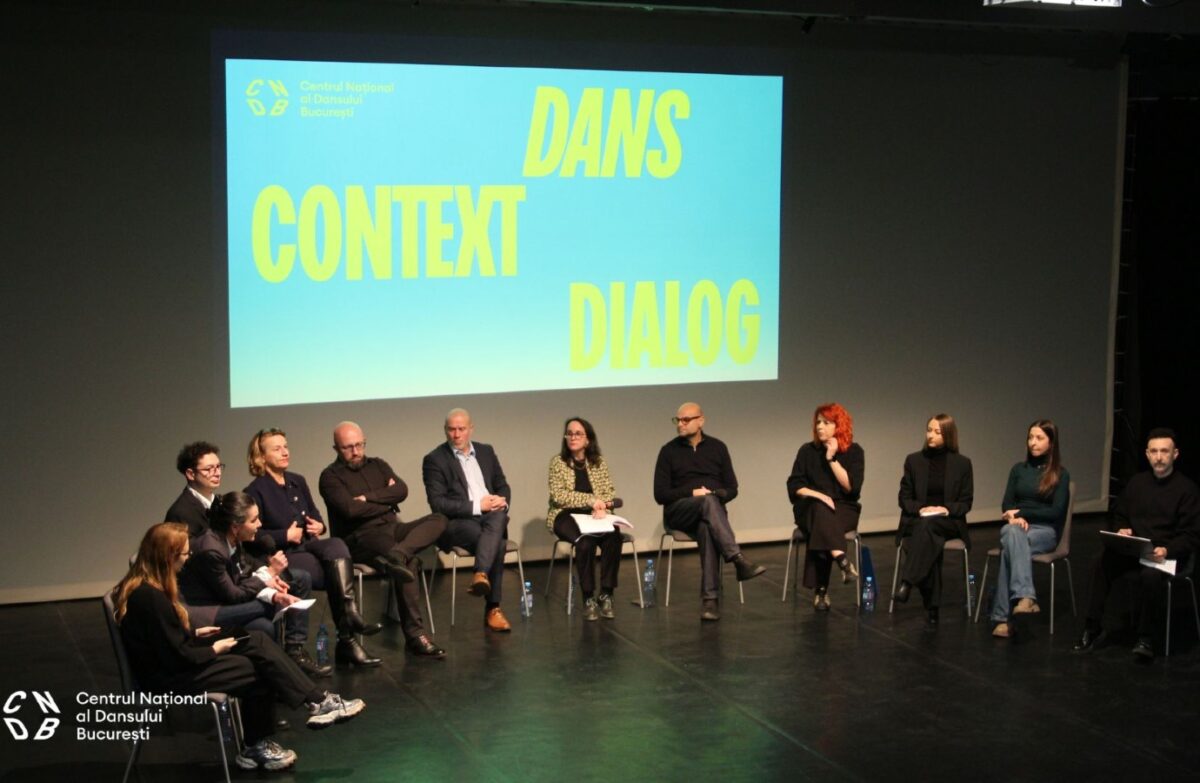
On January 29, 2026, the National Center for Dance Bucharest (CNDB) organized a public meeting between representatives of the contemporary dance community in Romania and the Minister of Culture, Mr. András István Demeter, with the participation of Mr. Bogdan Trîmbaciu, director of the Project Management Unit of the Ministry of Culture.
The meeting took place in the context of the loss of the Omnia Hall as the future headquarters of the CNDB, a cultural infrastructure project included in a financing agreement with the Council of Europe Development Bank, with an estimated allocation of approximately €13 million, which in 2024 reached in the phase of approval of the technical and economic indicators for the launch of the tender for execution.
Without warning, after eight years of difficult efforts, but with the design project completed and the approvals obtained, the institution was forced to cede its future headquarters to the Ministry of Internal Affairs. This is the second space promised and lost by the institution after another project publicly announced in 2013 by manager Ion Caramitru as the future headquarters of the CNDB disappeared from the Bucharest National Theater building complex, no longer appearing in the final version of the renovation and remodeling project for the TNB building.
At the meeting on January 29, representatives of the main structures and organizations in the field took the floor, including Vava Ștefănescu, CNDB manager, Mihai Mihalcea, CNDB Programs and Projects director, Arcadie Rusu (Linotip – Independent Choreographic Center), Simona Deaconescu (Tangaj Collective), Oana Mureșan (OM Choreographic Center, Cluj-Napoca), Camelia Neagoe (DeLaZero Association), Lavinia Urcan (Unfold Motion, Timișoara), Florin Fieroiu, choreographer, and Aura Corbeanu, cultural manager and vice president of the Romanian Theater Union. The discussion was moderated by performing arts critic Mihaela Michailov.
Community position
The meeting with the Ministry of Culture outlined a complex map of the structural needs of contemporary dance in Romania, beyond the specific issue of a building or a line of funding. The speakers described a field that functions through individual effort and informal solidarity, in the absence of a coherent public framework to ensure continuity, infrastructure, and professional prospects.
Representatives of the choreography sector highlighted the structural nature of the infrastructural and financial crisis in the field of contemporary choreography and dance, a major artistic sector in Romania without accessible infrastructure, without a national network of public centers, without institutional production mechanisms, and without predictable multi-annual funding.
Vava Ștefănescu, choreographer and manager of CNDB, stated:
“There is no more time for mere discussions. We need political will expressed in concrete mechanisms, in terms of access to resources, funding, and infrastructure. Without these tools, contemporary dance remains in a state of permanent vulnerability.”
Mihai Mihalcea, choreographer and program director at CNDB, said:
“The essential conditions for artistic existence are not individual, they are institutional. They do not depend solely on talent or effort, but above all on political decisions. The case of the Omnia Hall is not about a building, it is about the state’s ability to produce a compensatory solution when a government decision cancels a mature project that has reached such an advanced stage.
We are also talking about a structural imbalance in Romanian cultural policy that has been going on for several decades. The stake of this meeting is not our validation as artists, but the question of whether the state chooses to transform an institutional void into public policy once again.
Romania has approximately 70 public theaters and only one public institution with the mission of supporting and developing contemporary choreographic culture. Can you imagine what it would be like to have only one public theater in Romania, which has been underfunded and without adequate premises since 2011? We are not just talking about a sectoral problem, but about a permanent omission in public policy.”
Arcadie Rusu, choreographer and manager of Linotip – Independent Choreographic Center, emphasized that, in the absence of a committed public policy, the development of contemporary dance remains dependent on ad hoc and temporary initiatives and on the ability of independent organizations to compensate for what should be an institutional responsibility of the state. He pointed out that without a national framework, any progress remains fragmented and vulnerable to administrative changes.
Simona Deaconescu, coregrafă, directoare artistică și co-fondatoare a Tangaj Collective emphasized the direct link between infrastructure and the real possibility of producing art, explaining that funding without workspaces and presentation venues cannot generate a functional ecosystem. In his view, the lack of studios and stages blocks not only creation, but also the formation of audiences and the circulation of performances in the country.
Camelia Neagoe, choreographer and representative of the DeLaZero Association, drew attention to funding mechanisms, pointing out that current formulas tend to support project-by-project survival rather than medium- and long-term professional development. He indicated the need for multi-annual instruments that allow for planning, stability, and real artistic commitment. He indicated the need for multi-annual instruments that allow for planning, stability, and real artistic commitment.
Oana Mureșan, choreographer and founder of OM Choreographic Center and OM-Transylvania International Dance Festival in Cluj-Napoca, described the effects caused by the lack of infrastructure outside large cities, explaining that the absence of a regional network concentrates activity in a few urban centers and limits access for audiences in the rest of the country. From this perspective, the problem is not only a professional one, but also one of cultural equity..
Florin Fieroiu, choreographer and teacher, spoke about the disconnect between the education system and professional reality, emphasizing that the state produces generations of artists through schools and universities without building an institutional framework that would allow them to practice their profession in a sustainable manner. He presented this discontinuity as a loss of public investment in human capital.
Lavinia Urcan, choreographer and president of the Unfold Motion Association in Timișoara, added to this picture, pointing out that the lack of predictability and infrastructure pushes artists toward professional migration or toward leaving the field. In this sense, the problem of contemporary dance becomes one of retaining and developing cultural human resources, not just of providing ad hoc funding.
Together, these interventions have painted a coherent picture of a sector that requires not just occasional support, but a step change in the public approach: from isolated projects to long-term policies, from temporary solutions to sustainable infrastructure, from administrative reactions to a national strategy that links education, creation, funding, and public access in a functional and equitable system.
Clarification of the financing situation
Bogdan Trîmbaciu, director of the Project Management Unit at the Ministry of Culture, said the following about the availability of funds following the removal of the Omnia Hall from the framework agreement:
“No money has been lost. All the money that existed under the framework loan agreements is still available. We have four agreements with the Council of Europe Development Bank that include sufficient funds to build the future headquarters of the National Dance Center. This involves adding a new objective once a location has been identified.”
Acesta a precizat că, începând cu preluarea mandatului de către actualul ministru, au fost transmise „minim cinci adrese oficiale către alte instituții ale statului pentru identificarea unui spațiu adecvat pentru CNDB”.
Commitments of the Minister of Culture
During the meeting, Minister of Culture András István Demeter made a series of public statements and commitments:
“Initially, the National Dance Center also had the role of national funder. This has been lost. We can bring this role back. This really depends on me, and I can take on the task of revitalizing this funding authority component of the National Center for Dance.”
“Once I have the Ministry’s budget, I will set the CNDB budget so that we can restart these engines of funding authority. Not at full speed, but we will restart them.”
Regarding the identification of a solution for the CNDB headquarters, Mr. András István Demeter stated: “The Omnia Hall will be replaced with an alternative. We are not magicians, it cannot be done overnight, but we are working on identifying a space. There are alternatives and steps are being taken.”
Regarding the national network:
“The problem is not just one building in Bucharest. We need to think about a nationwide network, at least at the regional level, that would allow communities outside the capital to access infrastructure.”
Regarding the assumed mandate:
“I won’t give up on anything I’ve set my mind to, and I won’t give up on the things I can commit to.”
Conclusions and next steps
The meeting marked the first formal consultation between the contemporary dance community and a minister of culture since 2013. Participants called for a public work schedule to be established for identifying a new location for the CNDB headquarters, relaunching the mechanism for financing dance projects through the CNDB budget, and, in the long term, developing a regional network of infrastructure for choreographic creation and presentation, and increasing budget predictability through multi-annual financing.
The choreographic community has emphasized that it will publicly monitor the implementation of these commitments and will request regular updates on the progress of the measures undertaken by the Ministry of Culture.
The video recording of the entire meeting can be accessed HERE.
Main media partner
Radio Guerilla
Media partners
Zile și nopți, Scena9, Agerpress, Elle, Happ.ro, Liternet, TVR Cultural, Radio România Cultural, Revista Arta, The Institute, Zeppelin, ISCOADA, Feeder, Visit Bucharest, Ziarul Metropolis, IQads, Ceașca de Cultură, Modernism.ro, Haute Culture Magazine, munteanurecomanda.ro, Daily Magazine