ALL’ARME
- Dance & Performance
- Recommended age: 12+
55 min.
Info
The word alarm finds its origin in the Italian expression “all’arme!”, meaning “to arms!” or “to the weapons!” – a cry of warning historically used to incite readiness and defence in the face of imminent danger, such as an attack or invasion. “Arme” is the archaic form of “armi,” referring to instruments of defence or offence.
This etymology reveals that the concept of alarm is deeply intertwined with the act of preparing for battle, being ever vigilant and ready to defend oneself or respond to a threat. Over time, however, the meaning of “alarm” has evolved beyond its martial roots to encompass warnings of danger in a broader sense, extending to various situations of emergency.
Yet, as alarm prompts defence, it also raises questions: When does defence become aggression? How can we balance the need for protection with the risk of becoming a threat ourselves?
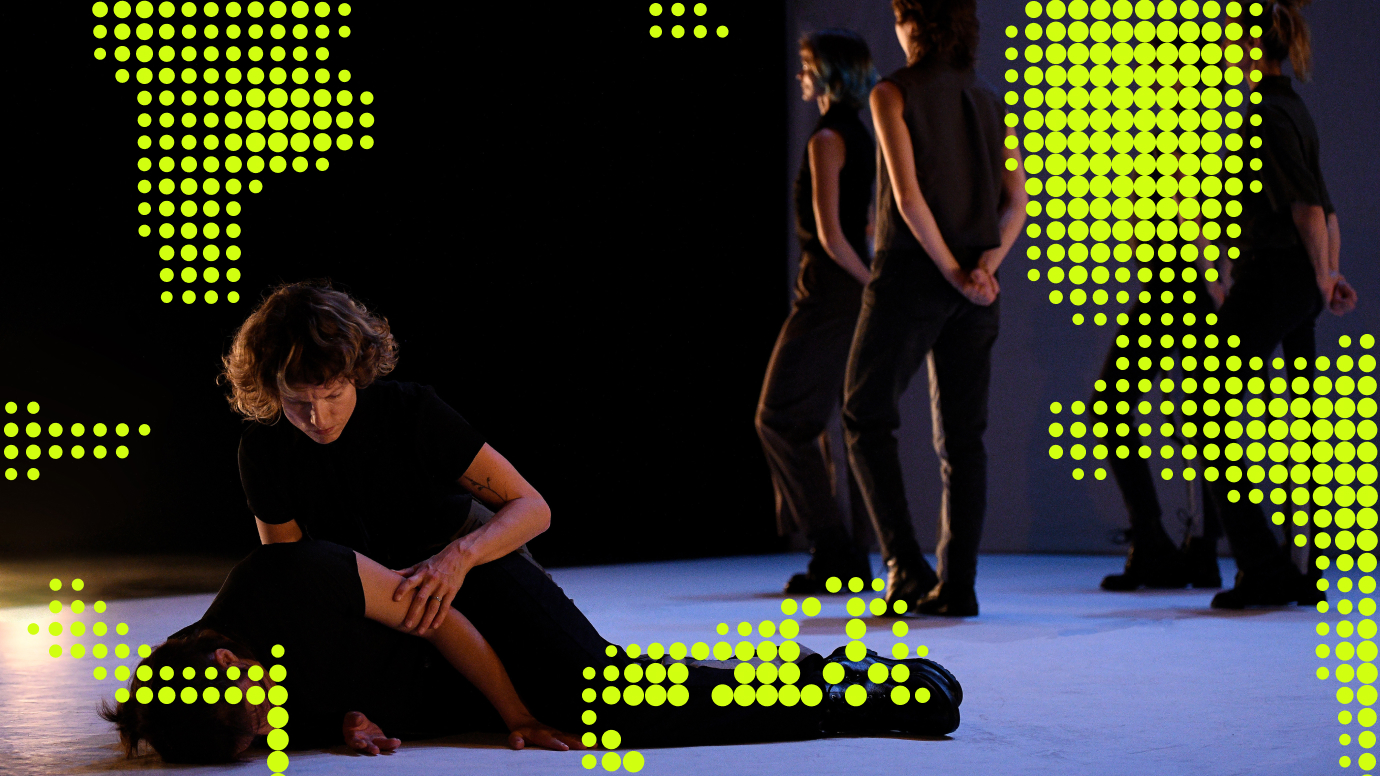
In this choreographic work for six dancers, Panzetti / Ticconi embark on a journey that begins with the rhythmic potential of the human step, exploring the persuasive power of synchronised and collective movement. Drawing inspiration from the military choreographic vocabulary, they delve into the tension between individual agency and collective force, questioning the fine line between necessary defence and the possibility of becoming what we fear.
Biographies
Ginevra Panzetti and Enrico Ticconi, based in Berlin and Torino, have been working as a duo since 2008. Their artistic research interlaces dance, performance and visual art. Deepening themes related to the historical union between communication, violence and power, they draw on ancient imaginaries, creating hybrid figures or images between history and contemporaneity. Both graduated from the Academy of Fine Arts in Rome and attended Stoà, School for rhythmic movement and philosophy in Cesena, led by Claudia Castellucci.
In 2010 they moved to Germany and delved into individual, but mutually complementary paths: Ginevra studied Media Art at the Hochschule für Grafik und Buchkunst (HGB) in Leipzig and EnricoDance, Context, Choreography at the Inter-University Centre forDance (HZT) in Berlin. They gained international recognition with their choreographic work Harleking (2018) that, among some of the most important international festivals, has been presented at the European platform Aerowavers Twenty 19, the New Italian Dance (NID) Platform and by Tanzplatform Deutschland 2020. In 2019 they won the 13th Arte Laguna Prize for the site-specific performance Jardin/Arsenale, they received the Danza&Danza Prize as emerging choreographers and were nominated “Promising Talent of the Year” by the JahrbuchTanz.
Their last artistic research investigates the symbolic power of the flag and took shape through the realisation of a diptych composed by two choreographic works (AeReA, 2019 and Ara! Ara!,2021) and was concluded with a filmic work (Silver Veiled / 2021). With AeReA they won the first edition of Premio Hermès Danza Triennale Milano, while Ara! Ara! has been supported by the Fondation d’entreprise Hermè swithin the framework of the New Settings Program. The filmic work Silver Veiled was commissioned by the Dublin Dance Festival and will be presented at the Torino Film Festival.
In 2021 they have been commissioned by the Berlin based Dance On Ensemble to realize their last group piece MARMO, a choreographic response to the work of Lucinda Childs. INSEL, their latest choreographic work for 4 performers premiered in 2023 at Tanz Im August Festival in Berlin.
They are currently collaborating with the Singapore-based company T.H.E. to create the network MALEBRANCHE – Harleking Multitude that will debut in June 2024 at the EsplanadeTheatre in Singapore.
Studio Contemporary Dance Company is the longest-standing dance ensemble in Croatia and the region, founded in 1962 in Zagreb under the artistic direction of Ana and Vera Maletić, shortly after the establishment of the School for Rhythmics and Dance and the beginning of the development of contemporary dance in Yugoslavia. From its inception, the Studio produced choreographies and dance films by its artistic directors but also motivated dancers to engage in their own creative work. With the arrival of Tihana Škrinjarić as artistic director in 1968, the ensemble began regular collaborations with the Komedija Theatre, performing in musicals, and increasingly securing engagements in television programs across Yugoslavia. Throughout this period, parallel to engagements that provided greater visibility and sustainability, the Studio Contemporary Dance Company continued to explore contemporary dance trends and to achieve numerous artistic guest performances and accolades, not only in the former state but also internationally, on both sides of the Iron Curtain.
In 1979, Zaga Živković became the artistic director, leading the ensemble until 1997, when Bosiljka Vujović-Mažuran took over. During this period, the Studio opened up to collaborations with an increasing number of external contributors: choreographers and theater directors with a more pronounced experimental approach to artistic exploration. The tendency towards bold steps into artistic experimentation and openness to various authorial poetics – whether from the Studio’s own members or from established domestic and international choreographers – remains a recognizable direction of the Studio Contemporary Dance Company to this day. Additionally, the Studio has continued to nurture space for the work of young dancers and choreographers, notably through the launch of the Male Forme program, also known as Studijev Studio, which offered young choreographers the opportunity to work with an experienced dance ensemble. In 2004, the Podmladak Studija za suvremeni ples (Youth Division of the Studio Contemporary Dance Company) was established, providing young dancers with pedagogical support for further professional development.
In 2019, Dina Ekštajn and Ana Mrak became the artistic directors, and the ensemble fully transitioned to a horizontal decision-making and self-management structure, where all members jointly decide on artistic production, internal organization, and activities. Among its numerous accolades, the most notable are the multiple Croatian Theatre Awards, as well as the professional award from the Association of Dance Artists of Croatia in 2012 for fifty years of activity, and in 2022 for sixty years of activity. In 2024 Martina Tomić became the artistic director.
Over the many years of work, generations of dancers who participated in the Studio’s activities and programs have remained loyal as an audience and sometimes even returned as choreographers. Now, on the occasion of the ensemble’s sixtieth anniversary, some of them are returning to the stage to pay tribute to the years spent in this unique dance community through an intergenerational performance.
Choreography: Ginevra Panzetti and Enrico Ticconi
Dancers: Martina Tomić, Ida Jolić/Ema Crnić, Viktoria Bubalo, Marta Krešić, Filipa Bavčević, Nastasja Štefanić-Kralj
Costumes: Tina Spahija
Music: Hrvoje Nikšić
Light: Tomislav Maglečić
Producer: Ivan Mrdjen
Public relations: Ivana Sansević
Visuals: Tihomir Filipec
Photo: Nina Đurđević
Produced by: Studio za suvremeni ples (SSP) – Studio Contemporary Dance Company
Financial support by: Republic of Croatia Ministry of Culture and Media, City of Zagreb, Zaklada Kultura nova, Instituto Italiano di Cultura di Zagabria
Coproduced in collaboration with the Pan – Adria network (ArtistiAssociati – Centro di Produzione teatrale, Gorizia; Zavod En–Knap, Ljubljana; Hrvatski kulturni dom na Sušaku, Rijeka; Zavod Flota, Murska Sobota via Ljubljana; Zagrebački plesni centar, Zagreb; Slovensko narodno gledališče Nova Gorica, Nova Gorica; Mediteranski plesni centar Svetvinčenat, Svetvinčenat)
Supported by Lavanderia a Vapore/ Fondazione Piemonte dal Vivo, in the frame of the residency program Lavanderia a Vapore, Collegno (TO), Kulturni centar Travno
Thanks: Zadar Dance Ensemble
Performance presented within the Moving Balkans Program, co-funded by Creative Europe.
*The views and opinions expressed are, however, those of the authors alone and do not necessarily reflect those of the European Union or the European Education and Culture Executive Agency. Neither the European Union nor the funding authority can be held responsible for them.
Iridescent 2026 partners
Institutional Partners
Ministry of Culture · Administration of the National Cultural Fund (AFCN) · Aerowaves · Moving Balkans · European Union · Onassis Stegi · Greek Embassy in Bucharest · Greek Union of Romania · Italian Cultural Institute in Bucharest · MNAC – National Museum of Contemporary Art of Romania · “I.L. Caragiale” National Theater · “Grigore Antipa” National Museum of Natural History
Cultural Partners
LINOTIP – Independent Choreography Center · /SAC @ Berthelot · Tangaj Collective Association · Cărturești · ANF | National Film Archive · Therapy for Movement · Petec Association · O2G Association · Teatre
Main Media Partner
Radio Guerrilla
Media Partners
Zile și Nopți · Matca Magazine · Scena Magazine · Arta Magazine · ELLE · TVR Cultural · Munteanu Recomandă · AGERPRES · VisitBucharest · Radio România Cultural · Haute Culture · Liternet · The Institute · Ceașca de Cultură · Daily Magazine · Modernism · Zeppelin · Iscoada · B-Critic · România Pozitivă

Funded by the European Union. Views and opinions expressed are however those of the author(s) only and do not necessarily reflect those of the European Union or the European Education and Culture Executive Agency (EACEA). Neither the European Union nor EACEA can be held responsible for them.